

The Leeds lads in the International Brigades
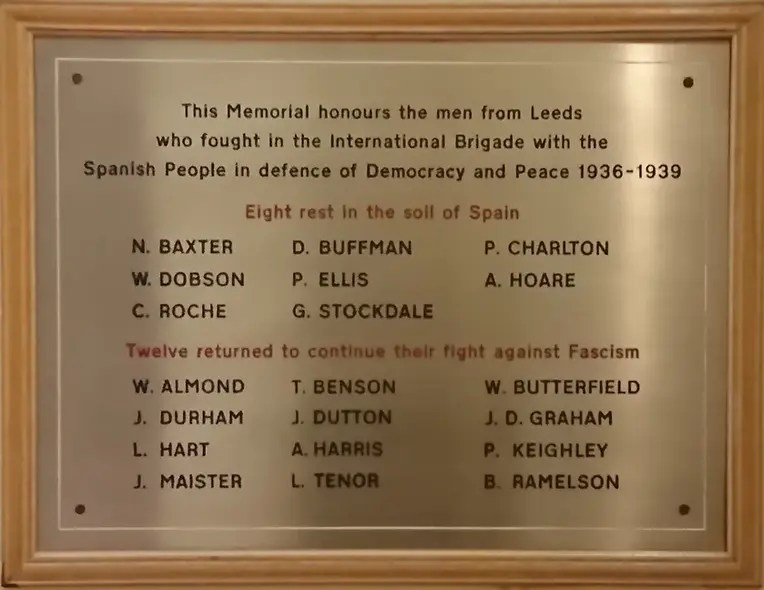
In 1989 a small plaque was unveiled in the City Hall of Leeds, by the then newly-installed socialist Leader of the Council Jon Trickett. It read:
‘This memorial honours the men from Leeds who fought in the International Brigade with the Spanish People in defence of Democracy and Peace 1936 – 1939’.
The plaque lists the names of 8 comrades who died and were laid to rest in Spain, and 12 who returned home to ‘continue their fight against fascism’. 50 years after the Republican defeat in the Spanish Civil War, the city of Leeds, hundreds of miles away from that physical and ideological frontier, remembered the men who had travelled to fight fascism.
The men memorialised on the plaque came from across Leeds and from a range of organisations and occupations. Similar plaques sit in town halls and municipal buildings across Yorkshire — in Rotherham, Doncaster, Hull and Middlesborough. [1]
Amongst the commemorated Leeds volunteers:
Norman Baxter, a shoemaker, travelled to fight in the Brigades with the support of the ‘National Union of Boot and Shoe Operatives’ and eventually died in Spain.
Thomas Benson, a plasterer involved with the Young Communist League, the Communist Party and the Operative Plasterers Union, came home from Spain, though badly wounded.
Phillip Ellis, a tailor’s cutter from Leeds, was shot dead whilst imprisoned at Jarama just outside of Madrid in 1937, having arrived in December 1936. Ellis was a member of the Communist Party and a member of the General and Municipal Workers Union (founder union of the now GMB).
What is known of the lives and journeys of the other men can be found below, with information collected thanks to the International Brigades Memorial Trust. [2]
The IBMT places a large caveat on some of their records, suggesting that researchers should interpret some of the negative comments within the records with a pinch of salt. With various factional conflicts at play within the European socialist, communist and anarchist blocs at the time, some records may have been altered by party leaders and bureaucrats for factional means.
There were likely more Yorkshire-based volunteers to the International Brigades than we know of. Richard Baxell found that many volunteers gave false addresses in London, with many volunteers listing the headquarters of various trade unions, political parties and organisations. [3]
It is estimated that between 2,500 and 4,700 British men travelled to Spain as volunteers, along with tens of thousands of others from around the world. [4] In Spain, an alliance of trade unionists, socialists, and communists had come together in a Popular Front to defend the elected socialist government of Manuel Azaña against Franco’s Nationalist uprising.
Throughout 1937, the Leeds Communist Party published the ‘Leeds Vanguard’. Articles were published in support of the socialist cause against fascism, backed by Hitler and Mussolini. Articles were particularly concerned with the anti-interventionist appeasement stance of the British and other European governments.
As an immediate precursor to the Second World War, the Spanish battle between reaction and revolution represented one of the first outright battles between fascism and socialism. Fearing that this battle would soon spread around the world, the Civil War was highly important to many who believed in the cause of labour and socialism. The Republican band received support from the USSR and communist groups around the world.
Within the Republican forces, there were, amongst many others, Marxists, anarchists, democratic socialists, and liberals. As with much of the history of the organised left, the Republican struggle was marred with ideological splits and purges. While Stalin’s USSR supported the Republicans, his forces found themselves at ideological loggerheads with more autonomous groups like the POUM.
POUM, the Workers’ Party of Marxist Unification, was an anti-Stalinist Marxist party whose membership had grown larger than the main, Soviet-backed Communist Party. It had been critical of the Popular Front strategy, but put its opposition aside in view of the shared struggle against fascism. George Orwell fought alongside the POUM during the Spanish Civil War, as did many of the British Independent Labour Party volunteers — the ILP and the POUM were both members of the International Revolutionary Marxist Centre organisation in the 1930s. [5]
However, when Stalin-aligned Comintern forces moved against POUM the British Communist Party newspaper, the Daily Worker, stated that POUM were responsible for the war, and that the party was working in league with the fascists to break up socialist and communist parties. An outlawing of POUM followed, and ILP leader John McNair was arrested as an alleged POUM agent whilst fighting in Spain.
The struggle of the volunteers represents a manifestation of international working-class solidarity, comprising workers, parties, trade unions and some sympathetic nation states. It serves as a shining example of comrades responding to the call of their international siblings. This international, material solidarity is less visible in the present day, where the globalisation of information through social media has seemingly restricted direct action beyond that plane.
Since the fall of the Soviet Union, international organisation today pales in comparison to the efforts of the Comintern, the World Festival of Youth and Students, and innumerable international exchanges amongst trade unions, parties, and socialist states. The Socialist International, while hopeful to represent democratic socialism across the world, has little teeth to organise a united front. Solidarity has been weakened further since 2012, when the mainstream ‘social democrat’ and ‘democratic socialist’ political parties split to form the Progressive Alliance.
The newly-formed Progressive International, with backers including Bernie Sanders, Jeremy Corbyn, and Yanis Varoufarkis, is a smaller coalition of radical and progressive parties, organisations, unions, news outlets etc. Were it to encourage more militant comrades to take up arms against fascism, it would doubtless cause another great leftist split.
Back to West Yorkshire, we should acknowledge the brave comrades of Leeds who travelled to fight fascism and defend the liberation of Spain’s oppressed labouring classes. Some of the volunteers from Leeds were caught up in internal ideological conflicts, as in the case of George Orwell. Some died and others returned home.
The Leeds Vanguard reported the death of volunteer Phillip Ellis whilst still fighting in Spain. It raised funds for his family in order to save them from destitution. Archive records in Leeds Library detailed the various political parties and unions who donated to the family’s fund. A final act of solidarity from left groups to a comrade who had travelled to fight fascism. [6]
A further act of international solidarity was the evacuation and settling of thousands of children from the Basque Country in the United Kingdom as fascist forces approached their homeland. Around 30 came to Leeds and were accepted into the community — this angered fascist General Franco, who saw the action as a violation of non-intervention.
Importantly, volunteers are commemorated in the municipal centre of the city they came from. Their commemoration serves as a reminder, particularly for today’s elected ‘socialists’ who pass the plaque, of the eternal fight for liberation. The willingness of those volunteers to lay down their lives shows an unfaltering commitment to liberation that remains necessary.
These few thousand words do not scratch the surface on the involvement of volunteers from Yorkshire who participated in the International Brigades, which we hope to examine further in future.
| https://international-brigades.org.uk/memorial/content-leeds/ | |||||
| LAST | FIRST | HOME | OCCUPATION | ORG | FATE |
| Baxter | Norman | Bradford | Shoemaker | NUBSO | Died in Spain |
| Charlton | Patrick | Leeds | Died in Spain | ||
| Ellis | Phillip | Leeds | Tailor’s Cutter | CP’34 and Tailors GMWU | Shot whilst a prisoner |
| Hoare | Arnold | Leeds | Clerk | Died in Spain | |
| Stockdale | George | Leeds | Despatch Clerk | CP/LP | Died in Spain |
| Almond | Clarence | Leeds | Railway Porter | Came home | |
| Benson | Thomas | Leeds | Plasterer | YCL, CP, Operative Plasterers Union | Came home, wounded |
| Butterfield | William | Leeds | Came home | ||
| Durham | John | Leeds | Electrical Worker | CP/LP | |
| Dutton | James | Leeds | Clerk | Came home | |
| Hart | Charles | Leeds | Soldier | Came home | |
| Harris | Abraham | Leeds | Upholsterer | YCL’33, AUU | |
| Keighley | Percy | Leeds | Engineer | CP’32 | Came home |
| Maister | Joseph | Leeds | Clerk | CP’32 | Came home |
Bibliography
[1] https://international-brigades.org.uk/?s=northeast&id=22600&post_type=memorial
[2] https://international-brigades.org.uk/memorial/content-leeds/
[3] Richard Baxell, The British Battalion of the International Brigades in the Spanish Civil War 1936-1939, 2001
[4] Richard Baxell, British Volunteers in the Spanish Civil War, 2012
[5] Peter Thwaits, “The Independent Labour Party Contingent in the Spanish Civil War”, Imperial War Museum Review, 1987
[6] Josh Flint and Scott Ramsey, University of Leeds https://secretlibraryleeds.net/2019/03/22/leeds-and-the-spanish-civil-war/


 Red Riding
Leave a comment