
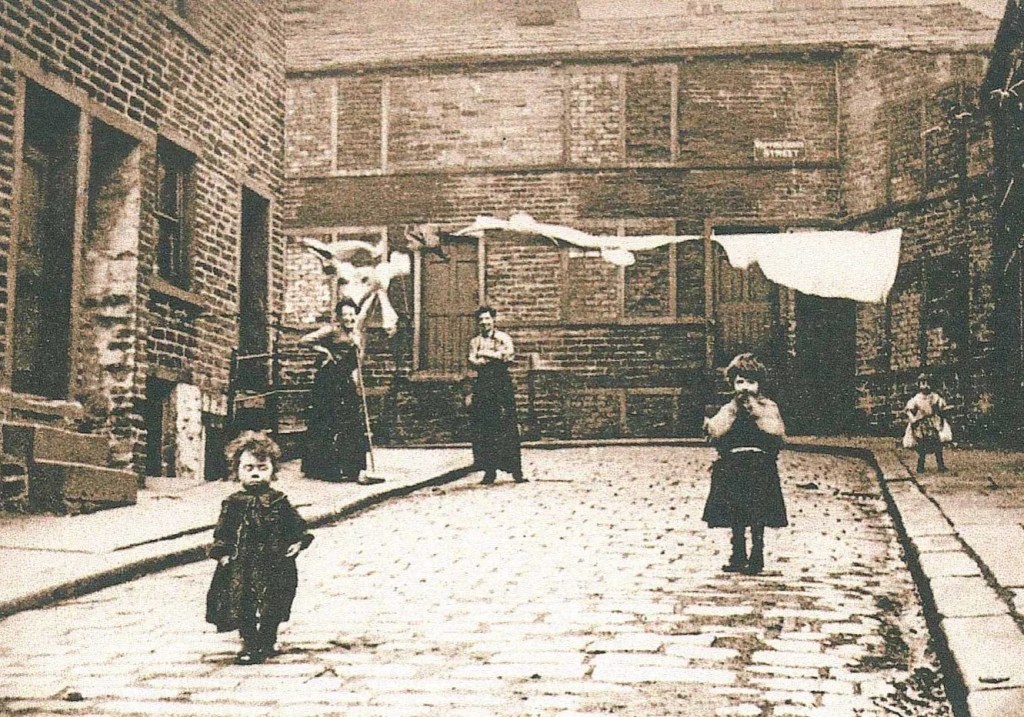
The eternal Yorkshire stubbornness, city living, and Victorian folk lessons for the 21st century world of work.
Folk music is undeniably integral to the cultural history of Yorkshire. While the often informal and serpentine movement of folk music across time and space makes it hard to strictly regionalise English folk, our region is well noted for its bountiful popular songbook composed over several centuries. Since the mid-century folk revival gave impetus to an appreciative and protective approach towards Britain’s musical tradition, many people have strived to preserve this songbook within Yorkshire’s collective musical conscience. The efforts of aficionados in collecting old songs, and the establishment of folk clubs and festivals to perform them, have aided in this mission.
Yet despite the success in keeping the folk tradition close to our hearts – many of us can still sing On Ilkla Moor Baht ‘at from memory – we often struggle to value its continued relevance to contemporary life. The decontextualisation of many traditional folk songs from the social and political context of their writing (not helped by the scarcity of readily-available primary information) can often produce little more than an aesthetic appreciation. This disregards their value as sources within a radical people’s history, and the continued relevance of the information coded within them.
The sustained popularity of folk music as a genre should be celebrated as a resistance to cultural totality. Still, something is lost when folk culture, the transcribed emotional expression of exploited people, is reduced to either its musical qualities or its kitsch appeal — the whimsical hauntology of a time often disregarded as primitive. Through our eyes, a line of demarcation is often drawn between pre- and post-industrial society; folk music can too easily be relegated to the former, seen as a precious, but outmoded relic from the times of rural economy. With it comes connotations of hard work, simple pleasures, folkloric customs and courting lovers, which can be romanticised and mysticised but also easily stripped of their sociopolitical context.
Much of Yorkshire’s unique songbook dates from industrial capitalist society, the society whose economic structure is the basis of our own. This continuity was stressed at the outbreak of the folk revival of the mid-20th century. Socialist musicians and music collectors — chief amongst them Ewan MacColl, father of Kirsty — collected, reproduced, and promoted the ‘work songs’ of the Victorian era amidst the growth of affluence and consumerism within British society. [1]
As E.P. Thompson sought to humanise social history and ‘rescue’ England’s working class ‘from the enormous condescension of posterity’, MacColl’s circle sought to appraise the working-class culture of the past amidst the rise of American rock imperialism. They shed light on the proletarian experience of history as expressed through music, a sentiment echoed by many in the decades that followed. As Yorkshire folk legend Norma Waterson once said, ‘Our oral history is what made us march. It’s what made us sing, it’s what made us happy, and it does deserve as much respect and dignity as any of those history books high on a shelf.’
As early as the late Victorian era, the usefulness of music as a means of preserving qualitative information surrounding the nature of life during socioeconomic tumult was already recognised by certain percipient figures in the region. Trapped in amber within the songs of the past are snapshots of a Yorkshire way of life and of thinking, products of economic and cultural pressures, which are both distant and incredibly analogous to our own.
The Dalesman’s Litany

One early visionary of this potential was F.W. Moorman, professor of English Language at the University of Leeds and President of the Yorkshire Dialect Society. He composed the Dalesman’s Litany (full text available here) around 1900 as a poem; it was later popularised during the revival among many other Victorian songs of toil.
Described by William Marshall as ‘a microcosmic Yorkshire epic’,[2] the song has been recorded by many folk greats from inside and outside Yorkshire, including Tim Hart, Cliff Haslam, and my fellow Barnsleyman Dave Burland, who made it the title track of an album in 1971. As its name suggests, the song is a verisimilar lament of a poor Dales-born farmer, forced by the Industrial Revolution to leave his home to trawl the burgeoning towns of the West Riding in search of work, encountering little but misery, backbreaking graft, and slum housing.
To re-introduce the Litany should come with the caveat that some purists may not consider it a folk song at all, despite its general acceptance as one. Owing to the commitments of its author, it represents more of a made-to-order folk song: a deliberate attempt to record social facts through poetry (specifically in broad dialect) rather than a traditional, organic piece passed down informally through generations. As well as this, Moorman himself was no Yorkshireman by birth: he self-described as ‘three quarters a Devonshire man and the rest Cornish’ and developed his near-fanatical devotion to Yorkshire through study.[3] All of this, however, does not preclude the Litany’s merit as an epic of Victorian folk, and a valuable source of Yorkshire popular-cultural history.
Moorman’s image of proletarian life in 19th-century Yorkshire is dire. His narrator laments the spartan conditions of labour and housing: driven from his home in the Dales, he travels ‘all three Ridin’s round’ and even goes to sea to ‘addle honest brass’, living in towns and cities ‘wheer fowks were stowed away / Like rabbits in a coop.’
As well as the grave material conditions, Moorman’s narrator laments the effect of proletarianisation on the human spirit. At the end of each verse, he pleads with God to deliver him from the Hell of Yorkshire’s industrial towns, elaborating an infernal portrayal of Northern industrial towns which was common in Victorian writings.
Comparisons between Bradford and Hell had been drawn in the 1840s by German poet George Weeth, and Engels wrote as much on the interpersonal destruction wrought by proletarianisation as he did on the economic hardship. He described housing in the towns of the West Riding as ‘ruinous, dirty, and miserable’, subject to the ‘evils incident to the customary method of providing working-men’s dwellings’,[4] but made a point of the ‘brutal indifference, the unfeeling isolation of each in his private interest becom[ing] the more repellent and offensive, the more these individuals are crowded together, within a limited space.’[5]
(De)industrialisation
The form of British state capitalism has undergone several overhauls since the Industrial Era. However, what remains at its base, and what has in fact intensified, is atomisation.
Atomisation was at the basis of Engels’ criticism of the social conditions of England’s industrial towns: ‘The dissolution of mankind into monads of which each one has a separate principle and a separate purpose […] Everywhere barbarous indifference, hard egotism on one hand, and nameless misery on the other’.[6] Marxism’s critique of capitalism has always been percipient, and this atomisation has only worsened in the neoliberal era. Individualism and an obsession with self-advancement has worn away many of the social bonds that enabled class consciousness.

Moorman’s record of the displacement and poverty which proletarianisation produced amongst the masses is ever more relevant today in the wake of Yorkshire’s ongoing deindustrialisation. Like its construction, the deconstruction of industry has wrought its own adverse effects on the population, distinct in their cause but similar in their social harms. Moorman’s narrator travels around Yorkshire, taking on work in the various different industries that had emerged in each town during the Industrial Revolution, concluding at the end of each verse that he would rather be at home in the Dales. Rural Yorkshire has historically been portrayed as a place of haunting mystery and poetic beauty. For Moorman’s narrator, it is held in contrast to the man-made horrors of the city: it is a home to which he fears never to return. His eventual homecoming is an object of longing prayers, which are eventually answered when he is able to retire there following a life of backbreaking toil.
The experience of the narrator, endlessly flitting from town to town in search of work, has a striking similarity to the pressures placed on today’s young people since the collapse of home industries like coal-mining and manufacturing. In the post-industrial era of the fragmented proletariat, young people are encouraged, if not forced by circumstance, to adopt a labour nomadism: moving around the county, the country, and even the world in search of suitable work, constantly retraining owing to unstable prioritisation of certain skills. Any tie to one’s community or desire for continuity must be sublimated to the necessity to remain employable, putting oneself totally at the whim of a volatile labour market.
These pressures are felt most intensely by the young: a ‘brain drain’ of young people seeking better opportunities outside of Yorkshire has seen the region suffer a net loss of nearly 10,000 under-25s in some years, with little sign of improvement.[7] A recent study showed that nearly 1 in 5 adults desire to relocate out of Yorkshire to find a better life.[8]
Nobody can blame Yorkshire’s young people for prioritising their material needs above their attachment to home, but with every move, the emotional tie to home is frayed and disintegrates, provoking further distress. The almost supernatural quality Moorman gives to the Dales as a timeless home gains a more poignant air when considering that he later died a premature death drowning in his beloved Dales. Many of us have a deep inextinguishable love for Yorkshire — for its natural beauty, its people, and the dense tapestry of its culture — but this love comes with the recognition that, outside of the large cities, there is little for us here materially.
Today
So what is to be done? The shock of industrialisation, laissez-faire capitalism and the grievous conditions which followed provoked strong resistance in Yorkshire. As well as giving impetus to trade unionism in the region, Luddism and Chartism arose, as did localised protests against the enclosure of rural land.
This class-conscious resistance, driven by the same discomfort with proletarianisation that Moorman’s narrator expresses, helped to cement the stereotype of Yorkshire people as stubborn and resistive. The universality of these traits is widely propagated: ‘You can always tell a Yorkshireman but you can’t tell him much.’ This stereotype was not necessarily new even in Moorman’s time, and was perhaps always inevitable given our relative geographic isolation from the rest of the country. Since the Norman conquest, we have sought to defend our independence from oppressive rule in various manifestations, different in form but driven throughout by a critical attitude towards power.
If only truly cemented in the Victorian age, the socialist nature of our stubbornness was reaffirmed during the miners’ strike, and its invocation in political discourse continues to this day. In 2022, Tory Lord Moylan caused controversy after describing us as ‘a county of leftist whingers begging for handouts’.[9] However, this resistive spirit could be at risk of disappearing. Attempts to resist today’s crises of capitalism at their social-economic root are restricted to the margins, in spite of the recognition of these issues in local news and within popular discourse. The flames of this marginalisation are fanned by the rightwards shift of Labour, galvanising popular rightist support and legitimising the state’s crackdown on grassroots opposition: in the face of seemingly unstoppable top-down reconstruction and re-destruction of our lives, complaining can feel like the highest exertion of resistance we are capable of.
Indeed, this is the conclusion of the Litany: after his retirement, the narrator and his wife are able to move back to a peaceful life on the Dales, where there are ‘fotty mile o’ heathery moor / Twix’ us an’ t’ coal-pit slack.’ The moral seems to be that, on the individual level, the suffering of proletarian life paid off in the end, and that the Good Lord did in fact deliver him as a reward for his life of exploited toil.
The conditions that push people to exert themselves in labour for a boss are the same conditions in which class consciousness will be founded. Our stubbornness can once again be our strength, if we learn to repurpose it, imbibed with political education, as unified resistance. In the legacy of the left folk-revivalists of the 1950s, ‘60s, and ‘70s, we must find ways to appropriate localised, individual displeasure towards capitalism’s forms into a generalised critique and opposition of its nature. It is not enough to spend our lives in misery then retire into comfort, we must demand comfort from cradle to grave.
Bibliography
[1] Sweers, Britta. Electric Folk: The changing face of English traditional music. New York, NY: Oxford University Press, 2005, pp. 32-3.
[2] Marshall, William. “An Eisteddfod for Yorkshire? Professor Moorman and the Uses of Dialect.” Yorkshire Archaeological Journal 83, no. 1 (2011): 199–217, p. 213. https://doi.org/10.1179/008442711×13033963454633.
[3] Ibid, p. 200.
[4] Engels, Friedrich. The Condition of the Working Class in England. London: Panther Books, 1969, p. 74.
[5] Ibid, p. 58.
[6] Ibid.
[9] https://www.examinerlive.co.uk/news/local-news/tory-lords-tweet-suggests-yorkshire-23090511


 Red Riding
Leave a comment