

Today, the 29th of September, Leeds Civic Trust will unveil a blue plaque to commemorate the Battle of Holbeck Moor, which took place 88 years ago this month. The plaque, which was initially suggested by Leeds Stand Up To Racism and Beeston resident Sam Kirk in January,1 represents the long-overdue commemoration of Yorkshire’s popular resistance to fascism. In spite of its relative obscurity within the national historic memory, what happened at Holbeck Moor was just as crucial to the prevention of a fascist takeover of interwar Britain as the more well-known confrontation at Cable Street, which followed a few weeks later.
As well as helping to address this imbalance in commemoration, and illuminating the work of historic anti-fascists, the plaque’s unveiling, bringing the events of the Battle back into the public imagination, comes at a time when the study of historical anti-fascist tactics could not be more imperative.
This summer, the people of this country confronted a threat strikingly similar to that which it faced nine decades ago, as our towns and cities were subject to coordinated, pogrom-like acts of racist violence, destruction, and intimidation. Taking the murder of three young girls in Southport as its green light, an opportunistic far-right movement bared its teeth and ignited a nationwide campaign of terror in which Northern England was particularly beleaguered. While the riots died down following strong-armed legislative action by the Government, they unmasked a creeping, seductive fascist movement which has only recently felt brave (or safe) enough to organise such large-scale acts of violence.
Comparisons between today and the 1930s can often be brushed off as alarmist, but the parallels are worryingly apparent. As the political elite grows ever more out of touch with the material concerns of its constituency, the opportunistic far-right launches increasingly organised violence, further delegitimising the liberal-democratic norm. This creates a vacuum of power — in which the left is marginalised — which someone must eventually occupy.
The nature of the Nazis’ rise to power in Germany and Italy is relatively well-known — I doubt any country has such a constant stream of televised documentaries about Nazism as ours. Nonetheless, a misconception of fascism as a strictly German, Italian, or otherwise ‘un-British’ ideology enables Tommy Robinson’s neo-fascists to deflect — ‘What’s fascist about carrying a Union Jack?’.
What’s more, it sustains the popular ignorance of how close Britain came to fascism in the 1930s, and how the efforts of communists, local communities, and strength through numbers were much more crucial to its defeat than any bourgeois political power-plays.
Holbeck Moor
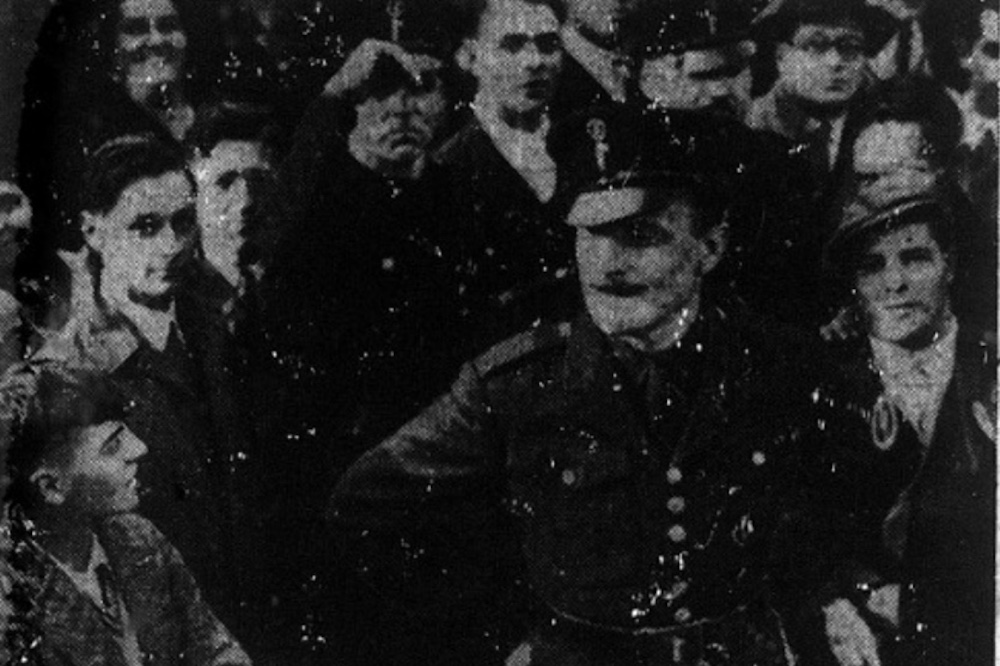
The British Union of Fascists — Oswald Mosley’s vanguard party of interwar fascism — decided to march in Leeds for predictably opportunistic reasons. From the Union’s formation in 1932, its leaders, Mosley chief amongst them, had sought to create a support base hinged on class collaboration. The despair brought by the Great Depression and unemployment was seized upon by the party to recruit working-class supporters (predominantly out of its nucleus in London’s East End). At the same time, Mosley, who was himself a Baronet, courted the bourgeoisie and aristocracy, most importantly seducing Viscount Rothermere, chair of the Daily Mail and avid fascist supporter.2
This approach had brought Mosley considerable early success — bolstered by Rothermere’s support, the party claimed some 50,000 members within its first two years. The summer of 1934 saw a wave of fascist thuggery, culminating in a clash at a BUF rally at Olympia in London, where anti-fascist protesters were brutalised and removed by the police, handing the fascists a propaganda victory.3
Yet as the Union grew to resemble German and Italian fascism more closely (appropriating the use of modernist symbolism and uniformed militiamen eager for confrontation) its middle- and upper -class supporters became squeamish.4 By 1936, Mosley had changed tactics and sought to reach the working class more directly, aiming to expand his influence into the poverty-stricken cities of Northern England.
Leeds, with its heavily working-class industrial population feeling the effects of unemployment and economic misfortune, seemed an apt choice for Mosley’s thugs to show their strength. In September 1936, Mosley organised a march in the city, originally opting to rally in the Leylands — an impoverished area of the city which had, in the decades prior, seen prejudice towards its large Jewish population worsen to the point of race riots.5 When the local City Watch forbade him to march in the area, he moved his march of provocation to Holbeck, hoping to exploit the working class’ appetite for a break from the political dichotomy.
After Mosley set the date for the 27th of September, the Communist Party — which already had a strong presence in the area — mobilised a counterbloc. Though the Labour Party refused to officially endorse the opposition march, the thousand Blackshirts that Mosley had sent into the city were met with counter-protesters outnumbering them thirty to one.6
As the fascists marched down Briggate and towards Holbeck, where Mosley was orating from the roof of a van, they were pelted with stones, one of which hit Mosley in the temple. As one fascist (bitterly) recollected years later, ‘They would stand at the top of each side road, pelt us with stones, half bricks and potatoes studded with razor blades and then run for their lives back down the side streets.’7 Around forty fascists were injured, with fourteen requiring medical attention, and the BUF rally was forced into a premature retreat.8
The success of the Communists in organising the people of Leeds in opposition to fascism sent a clear signal to Mosley that any effort to recruit the Yorkshire proletariat would likely be in vain. This led him to return to London, which led to the legendary Battle of Cable Street weeks after the Holbeck defeat. In the build up to the confrontation in Whitechapel, the success of the Leeds Communists was used as a rallying tactic by the left: one Daily Worker article declared that ‘what happened in Leeds must happen in East London!’ and, in a damning blow to the BUF, it did.9
Unveiling a plaque commemorating the defeat of the fascists in Leeds serves a dual purpose. On the one hand, it helps to correct a historiographical injustice where the Holbeck defeat has received minimal recognition compared to the thwarting at Cable Street which followed it. Yet more pertinently, it reminds us of the unquestionable importance of strength through numbers.
It would be hubristic to offer a singular answer for what the left must do to eradicate this new scourge of organised fascists. What matters most in the immediate future is engaging local communities, expanding communications, and coordinating efforts, so as to outnumber fascists on the ground and physically dominate space. Beyond blue plaques, the way to honour the memory of the 1930s anti-fascists is to study their tactics, in the hope of replicating their successes. What happened in Leeds must happen from London to Liverpool to Leith.
Bibliography
- https://southleedslife.com/plans-for-blue-plaque-to-mark-battle-of-holbeck-moor/
- Bret Rubin, “The Rise and Fall of British Fascism: Sir Oswald Mosley and the British Union of Fascists,” intersections 11, no. 2 (2010): 323-380, p. 360.
- https://hatfulofhistory.wordpress.com/2018/09/09/from-olympia-to-hyde-park-british-anti-fascism-in-the-summer-of-1934/comment-page-1/
- Rubin, p. 367.
- https://tribunemag.co.uk/2020/09/remembering-the-battle-of-holbeck-moor-leeds
- https://secretlibraryleeds.net/2019/06/14/oswald-mosley-and-leeds-the-battle-of-holbeck-moor-27th-september-1936/
- https://chrisnickson.co.uk/2014/11/20/the-battle-of-holbeck-moor-a-leeds-story-but-a-true-one/ (see comments section).
- https://tribunemag.co.uk/2020/09/remembering-the-battle-of-holbeck-moor-leeds
- Ibid.
- https://southleedslife.com/plans-for-blue-plaque-to-mark-battle-of-holbeck-moor/ ↩︎
- Bret Rubin, “The Rise and Fall of British Fascism: Sir Oswald Mosley and the British Union of Fascists,” intersections 11, no. 2 (2010): 323-380, p. 360. ↩︎
- https://hatfulofhistory.wordpress.com/2018/09/09/from-olympia-to-hyde-park-british-anti-fascism-in-the-summer-of-1934/comment-page-1/ ↩︎
- Rubin, p. 367. ↩︎
- https://tribunemag.co.uk/2020/09/remembering-the-battle-of-holbeck-moor-leeds ↩︎
- https://secretlibraryleeds.net/2019/06/14/oswald-mosley-and-leeds-the-battle-of-holbeck-moor-27th-september-1936/ ↩︎
- https://chrisnickson.co.uk/2014/11/20/the-battle-of-holbeck-moor-a-leeds-story-but-a-true-one/ (see comments section). ↩︎
- https://tribunemag.co.uk/2020/09/remembering-the-battle-of-holbeck-moor-leeds ↩︎
- Ibid. ↩︎


 Red Riding
Leave a comment