
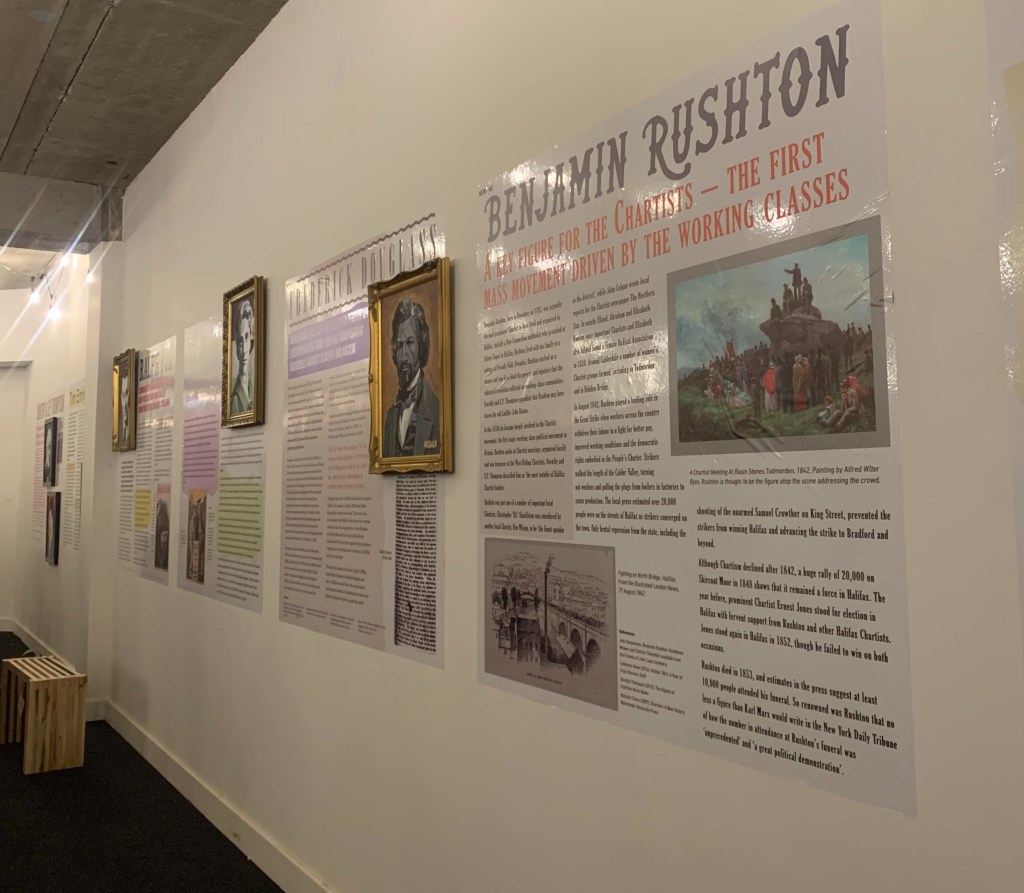
With its sprawling hills, romanticised moors and great feats of Georgian architecture, it could be said that Halifax’s known history – in the minds of the general public, at least – has often fallen victim to the period drama. The story of Anne Lister – ‘the first modern lesbian’, protagonist of the BBCs ‘Gentleman Jack’ and widely documented upper-class Conservative mine owner – stands at the forefront of the town’s otherwise expurgated story.
However, this month, tucked away in the Culturedale pop-up gallery in Northgate House, a new exhibition stands to challenge just that. Radical Halifax is, as its creators describe, ‘a unique art exhibition, historical enquiry, and political intervention that seeks to recover hidden histories of our town’s radical past and demonstrate how people
from, or with a strong connection to, Halifax have played important roles in transformative movements that sought to build a better world’. This Wednesday I attended their opening and press night, which was a great opportunity to preview the exhibition, hear from its creators and speak to Dan Whittall, one of the three minds behind the project.
The exhibition itself is simple, but informative and engaging. Taking an infographical approach, each wall of the gallery is adorned with a line up of a total nine historical counter-figures – oppositional political individuals, all with a significant link to the town. The radical gang range from 19th century Chartists, to 20th Century communists and musicians, to 21st century Labour MPs. Each historical profile is accompanied by an original portrait from local artist Marcus Jack, whose work not only depicts the likeness of the figures, but also gives an insight into their politics and causes.
It can often be tricky to categorise such an array of individuals, stories and causes under one political or historical umbrella; at Red Riding we have often played with different taglines, contesting on whether its ‘people’s history’, ‘radical history’ or another term that best describes what we are trying to write. Halifax’s exhibition justifies its use of the word ‘radical’ etymologically at the entrance (an approach Whittall jokingly attributes to his teaching background), focusing on its latin origin of ‘radix’, meaning ‘root’ and linking that to the ways radical individuals seek to attack the roots of social issues and re-root society. Nevertheless, I’m sure some would still critique the use of such a word to describe a former Labour MP.
Perhaps what best unifies the different subjects of the exhibition instead, is the fascinating intersections that can be spotted between them. Vanguard to this is the exhibition’s profile of Frederick Douglass, the infamous abolitionist who escaped slavery in the plantations of the American South in 1818 and, surprisingly, lived in Halifax from 1859-60. As well as detailing his vigorous global campaigning against slavery and racism, the profile also mentions Douglas’ later links to Chartism, intertwining his story with those displayed on the neighbouring graphics.
The exhibition is on for just a 10 day run, but its creators have hopes to be able to find a more permanent space for it in Halifax going forwards. As co-creator Michael Ainsworth noted at the press launch, these hidden histories have often gone untold in mainstream narratives of Halifax’s history and must be promoted. However, finding space for radical history in mainstream museums and public spaces is a difficult task and there are many obstacles to their exposure beyond the echo-chambers of leftist politics. Projects like this often rely on the generosity of volunteers and donations, rather than gaining the funding and support they need from the mainstream culture and heritage sector. Nevertheless, if we want a different politics in Britain today, a better curated, more diverse public historical-political education is paramount.
It can be said that this kind of work then is not just writing radical history, but writing history radically; organising amongst comrades, collaborating with different groups and relying on the solidarity of others to get a project like this off the ground. Until mainstream organisations open up to more exhibitions like this, these projects need our support.
Radical Halifax is open from 10th-20th October at the Culturedale pop-up gallery in Northgate House. There will be a talk given from Dan Whittall on Saturday 19th October at 11am and a performance from band Attila The Stockbroker on Sunday 20th. The exhibition is free to enter for all, but a donation can also be made upon your visit.


 Red Riding
Leave a comment